Indoor Cat Enrichment: DIY Toys, Play, Home Setup
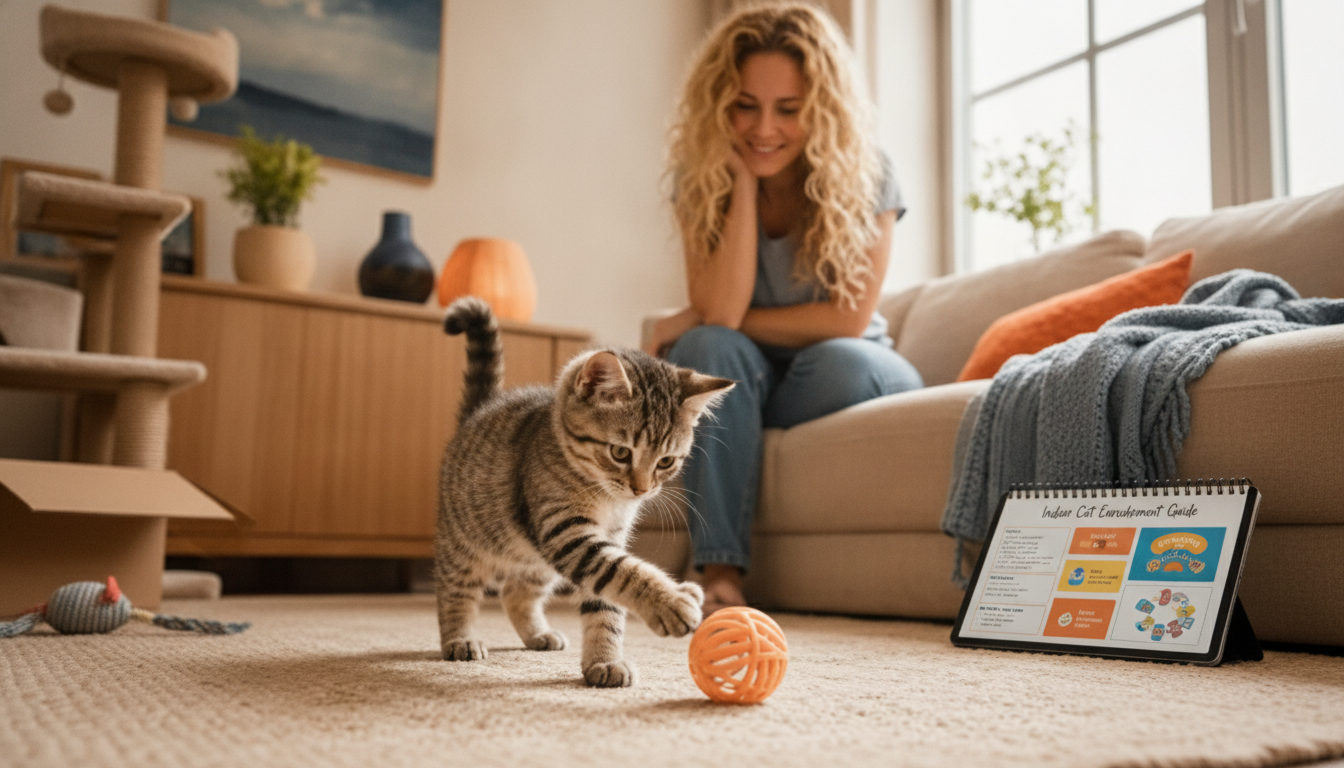
Enrichment Ideas for Indoor Cats: DIY Toys, Play Routines, and a Cat-Friendly Home
Indoor cats thrive when their day includes hunting-style play, opportunities to climb and hide, and small changes that keep their environment interesting. The ideas below focus on practical routines, low-cost DIY toys, and room-by-room home tweaks that support healthy movement, reduce boredom, and encourage natural cat behaviors—plus a printable guide that makes it easy to stay consistent.
Start With Your Cat’s Enrichment Basics
Good enrichment doesn’t need to be complicated—it just needs to match what cats are built to do. When you aim your setup and routines at natural behaviors, you’ll often see better sleep, fewer “random” zoomies, and calmer attention-seeking.
- Focus on natural behaviors: stalk, chase, pounce, climb, scratch, chew, and rest in safe, elevated spots.
- Use variety: rotate toys and activities to keep novelty high without buying more items.
- Balance energy and calm: pair active play with wind-down routines (food puzzles, grooming, or a quiet perch).
- Watch for stress signals: hiding more than usual, overgrooming, sudden aggression, or nighttime zoomies can indicate unmet needs.
For deeper background on feline environmental needs and behavior, helpful references include the American Association of Feline Practitioners (AAFP) Feline Behavior Guidelines and International Cat Care’s environmental advice.
Daily Play Routines That Mimic a Hunt
Most indoor cats respond best to short, high-quality play sessions that feel like a real hunt. Think “tiny sprints,” not marathon workouts.
- Schedule 2–3 short sessions (5–10 minutes each) rather than one long session; many cats respond better to brief bursts.
- Use a simple sequence: warm-up (slow movements) → chase (faster) → capture (let the cat “win”) → cool-down (treat or small meal).
- Vary the “prey”: ground skitters, mid-air flutter, and behind-the-couch escapes keep engagement high.
- End with success: always allow a catch and a calm transition to prevent frustration.
Sample 7-Day Indoor Cat Enrichment Routine
| Day | Active Play (5–10 min) | Brain Work (5 min) | Home Setup (2 min) |
|---|---|---|---|
| Mon | Wand toy with pauses and sudden darts | Treat in a folded towel “snuffle” | Rotate one toy into a new room |
| Tue | Laser pointer followed by a physical toy catch | Hide 5 treats on a cat tree | Open a window perch (supervised) |
| Wed | Ball track or hallway fetch-style toss | Cardboard box “find it” game | Move scratching post near nap spot |
| Thu | Ribbon/feather lure around furniture corners | DIY puzzle cup with kibble | Swap out one blanket for a new texture |
| Fri | Kick toy wrestling session | Clicker basics: target a spoon | Add a paper bag hideout (handles removed) |
| Sat | Staircase chase with a soft toy | Scent enrichment: catnip/silvervine cloth | Reposition a perch to face activity |
| Sun | Slow “stalk and pounce” with a plush mouse | Scatter feed in two rooms | Tidy and reset: remove 1 toy, add 1 toy |
DIY Enrichment Toys From Household Items
DIY toys are perfect for boosting novelty. Keep them simple, make a few at a time, and retire anything that starts to fray or shed small bits.
If you want a ready-to-print set of ideas you can rotate without thinking too hard, use Enrichment Ideas for Indoor Cats | Printable Cat Enrichment Guide | DIY Toys, Play Routines, and Cat-Friendly Home Tips.
Food Puzzles and Foraging Games (Without Overfeeding)
Cat-Friendly Home Tips: Vertical Space, Scratching, and Rest Zones
To build calmer routines and avoid accidentally pushing a shy or easily overstimulated cat too fast, Understanding Your Pet’s Temperament: A Complete Guide to Decoding Dog and Cat Behavior for Better Care and Training can help you match play style, handling, and home setup to the personality you’re working with.
Scent, Sound, and Visual Enrichment That Feels New
If your cat relies heavily on hiding to cope, it helps to map out where “safe” really is (and where it isn’t). A Guide to Safe Space Mapping | Digital Ebook on Understanding, Creating & Using Safe Spaces is a practical way to plan rest zones and retreat routes so enrichment doesn’t become overwhelming.
Make It Easy to Stick With: Printable Guide and Simple Tracking
- Use a weekly checklist to rotate activities (play, foraging, training, new textures) without guessing what to do next.
- Track quick notes: favorite toys, best play times, stress triggers, and which puzzles are the right difficulty.
- Keep a “toy library”: store most toys out of sight; bring out 3–5 for the week to maintain novelty.
- Pair enrichment with existing habits: play before meals, puzzle feeding after breakfast, grooming after the evening session.
- Printable resource: Enrichment Ideas for Indoor Cats | Printable Cat Enrichment Guide | DIY Toys, Play Routines, and Cat-Friendly Home Tips
For additional guidance on keeping indoor cats engaged in healthy, humane ways, the ASPCA’s cat care resources offer practical enrichment and wellness pointers.
FAQ
How much play does an indoor cat need each day?
Many indoor cats do well with about 15–30 minutes of interactive play total per day, split into 2–3 short sessions. Adjust for age, mobility, and temperament, and remember that climbing, foraging, and puzzle feeding also count as meaningful activity.
What are easy enrichment ideas for indoor cats when time is limited?
Try a 5-minute wand session, scatter a small portion of kibble in two rooms, tuck treats into a folded towel “snuffle,” rotate one toy from the closet, or set up a supervised window perch. Small, repeatable actions add up quickly.
Are DIY cat toys safe?
They can be, as long as you supervise and avoid strings, elastic, or loose parts that can be swallowed. Check DIY toys often for wear, remove paper-bag handles, and toss anything that starts to shred, splinter, or shed small pieces.











Leave a comment